Tiranga Colour Prediction: How It Works
How a round of the Tiranga game colour prediction actually works, the real probability behind red, green and violet, and why “100% accurate” predictions and “sure-shot” charts cannot exist.
Type “tiranga prediction” into Google and you will be buried in “100% accurate” charts, paid Telegram tips and “AI predictor” APKs. This page does the opposite: it shows you, with the actual maths, why none of those can win at the Tiranga game — and gives you a small tool to prove it to yourself.
How a colour-prediction round works
The Tiranga game format is deliberately simple, which is part of the appeal:
- A round opensEach period lasts a short, fixed time — often under a minute — shown by a countdown timer.
- You place a betYou pick an outcome: a colour (red, green or violet) or a number, and stake an amount.
- Betting closesA few seconds before the result, bets lock so no one can react to the outcome.
- The result is drawnA colour/number is produced; winning bets pay a fixed multiple, losing bets are gone.

The real odds behind the colours
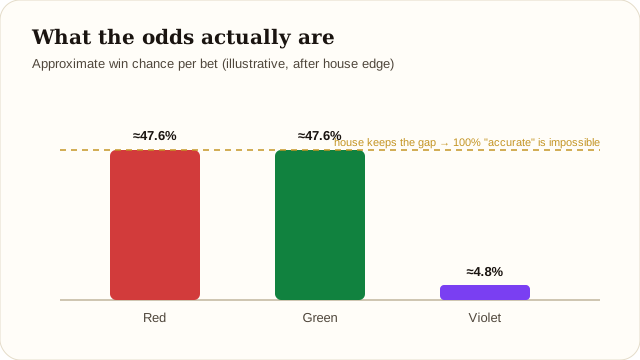
The colours map onto numbers (commonly 0–9). In a typical layout, red and green each cover most of the numbers while violet covers a small overlap. That is why violet “pays” far more than red or green — it is rarer. Crucially, the payouts are set below the true odds, so the platform keeps a slice of every round on average. That slice is the house edge.
Why “100% accurate prediction” is impossible
Each round is independent and chance-based. Past results do not change future ones — a run of five reds does not make green “due.” That belief is the gambler’s fallacy. Because outcomes are random and the payout is set below fair value:
- No chart, pattern or “sure-shot” PDF can predict the next result — the ones you see ranking are often just thin documents uploaded to free hosts.
- No “AI predictor” app can beat a random draw; many are simply malware or ad-revenue traps. See our review on the “predictor” scam.
- Paid prediction channels profit from your subscription, not from winning. If they could really predict it, they would not sell tips for ₹299.
Prove it to yourself
Use this small explainer. Enter a stake, your win chance, and the payout multiple. It shows the expected value — what an average round is worth to you. When the number is negative, that is the house edge quietly working against you, round after round.
Odds & house-edge explainer
See why a bet that “pays double” still loses money over time. Enter a stake and a payout multiple.
Educational illustration only. The real edge varies by game; this is not betting advice and not a predictor.
The colour-to-number mapping
Most versions draw a single digit from 0 to 9 and map it to a colour. A common layout looks like this — check your specific game, as variants exist:
| Result | Colour | Roughly how often |
|---|---|---|
| 1, 3, 7, 9 | Green | ~40% of digits |
| 2, 4, 6, 8 | Red | ~40% of digits |
| 0 | Red + Violet | ~5% (overlap) |
| 5 | Green + Violet | ~5% (overlap) |
This is why violet pays a much bigger multiple: it only lands on the two overlap digits, so it is rare. The payout is tuned so that, even accounting for how often each outcome appears, the platform keeps its edge. There is no “safe” colour — only different combinations of probability and payout that all average out in the house’s favour.
The popular “strategies” — and why they fail
- Martingale (double after a loss): the idea is that a win eventually recovers everything. In reality, a normal losing streak quickly hits the table limit or empties your wallet — and the house edge means the expected result is still a loss, just a faster one.
- Pattern / trend reading: “it has been red five times, green is due.” Each round is independent, so past colours tell you nothing about the next — this is the gambler’s fallacy, and it is exactly what keeps people betting.
- Following a paid “prediction” channel: they post enough mixed calls that some look right in hindsight, then charge for the “VIP” signal. They profit from subscriptions, not predictions.
- “AI predictor” apps: no algorithm can forecast an independent random draw. Many of these apps exist to show ads or harvest data.
What 100 rounds really looks like
Imagine betting ₹100 on a roughly even-money colour for 100 rounds, with the payout set slightly below fair. On any single round you might win or lose — that swing is what makes it feel beatable. But sum it up and the small built-in edge applies to every round, so the expected total is a steady drain, not a coin-flip you can outsmart. The longer you play, the more certain the loss becomes. That is not bad luck; it is arithmetic, and it is the whole reason the game exists. Use the tool above to see the per-round expected value for your own numbers.
Are the results rigged, or just random?
Here is the uncomfortable nuance: the house does not need to rig anything, because a fair random draw with a below-fair payout already guarantees its profit. That said, an unregulated app gives you no independent proof that its draws are genuinely random — there is no audited RNG certificate or “provably fair” verification the way a regulated casino would publish. So you are trusting an operator with no accountability that the game is even as fair as the maths assumes. Either way — fair-but-edged or worse — the rational expectation for the player is to lose.
Quick glossary
Three terms explain almost everything about why the game behaves as it does:
- House edge: the built-in percentage the platform keeps on average because payouts are set below fair odds. It is small per round but relentless across many rounds.
- RTP (return to player): the flip side of the edge — the share of all stakes paid back over time. An RTP below 100% (always the case here) means players, as a group, get back less than they put in.
- Variance: how wildly results swing in the short term. High variance is why you can win for a while and feel skilled — but variance averages out, and what is left is the edge.
Put together: variance gives you the hope, RTP and the house edge collect the bill. No prediction tool touches any of these numbers, which is why none of them can make you a long-term winner.
Colour-prediction FAQs
Can you predict the Tiranga colour result?
No. Each round is independent and chance-based, and payouts are set below fair odds, so no chart, app or pattern can reliably predict the outcome. “100% accurate” claims are false.
Why does violet pay more than red or green?
Violet covers fewer numbers, so it wins less often. The higher payout reflects its lower probability — it does not make it a smarter bet, because the house edge still applies.
Do prediction charts and AI predictors work?
No. Free-host “prediction chart” PDFs and “AI predictor” APKs cannot beat a random draw. Many are ad traps or malware. Paid tip channels profit from subscriptions, not winnings.
What is the house edge?
It is the gap between the true odds and the payout. Because winners are paid slightly less than fair value, the platform keeps a small percentage of all bets on average, which is why players lose over time.
Play with your eyes open
Now you know the maths. If you still want to play for fun, register and set a strict deposit limit first — never chase a loss.